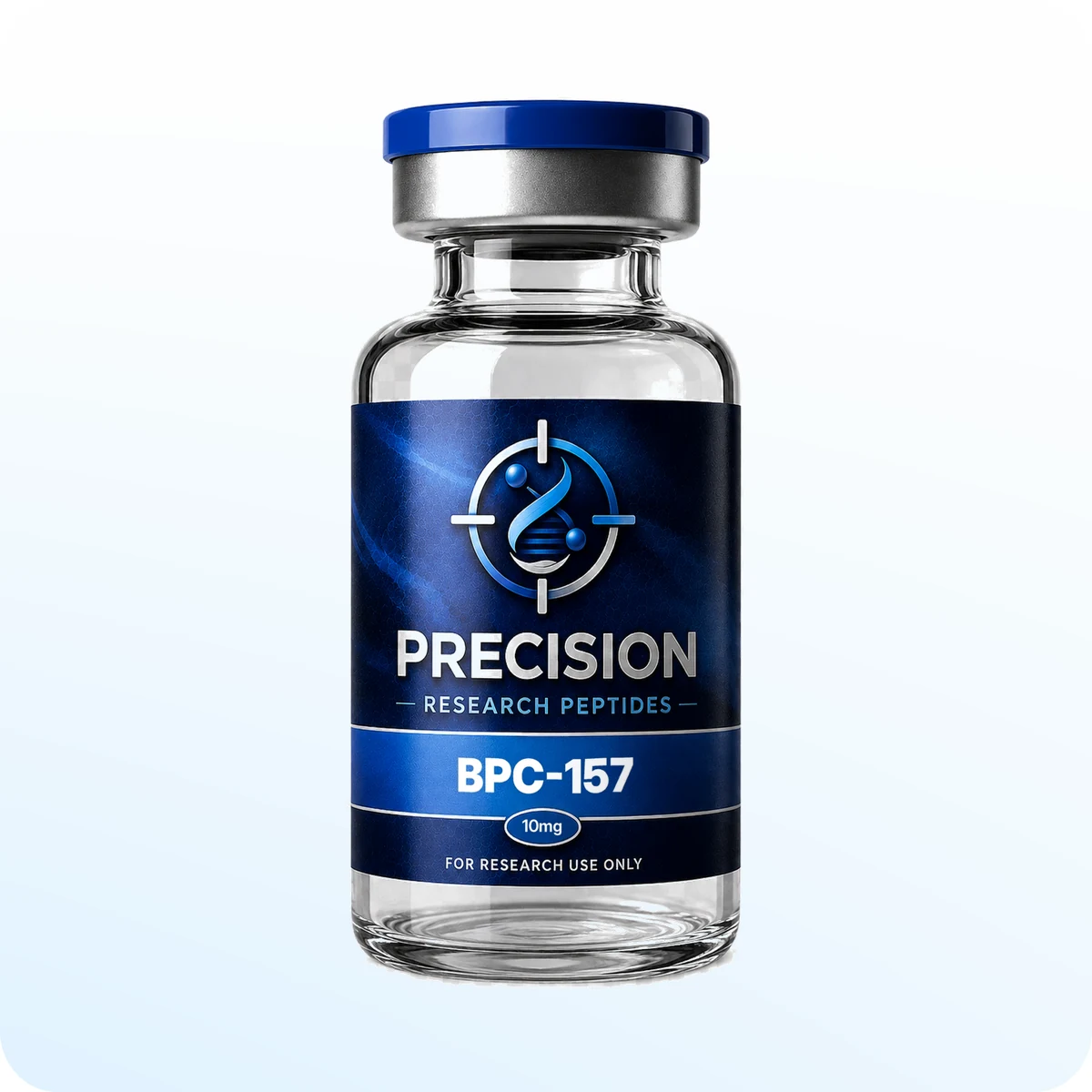
$65.00 Original price was: $65.00.$60.00Current price is: $60.00.
Synthetic pentadecapeptide supplied for angiogenic-signaling and fibroblast-migration research models.
All major credit cards accepted

BPC-157 is a synthetic pentadecapeptide: a stable, 15-amino-acid sequence (Gly-Glu-Pro-Pro-Pro-Gly-Lys-Pro-Ala-Asp-Asp-Ala-Gly-Leu-Val) derived from a partial sequence of a protein identified in human gastric juice. As a research compound, it is characterized by marked stability in aqueous and acidic conditions relative to many peptides, a property that has made it a frequent subject of laboratory investigation. In the preclinical literature it has been studied in research on angiogenic signaling, connective-tissue and matrix remodeling, and cytoprotective pathways across a range of in vitro and animal model systems. Precision Research Peptides supplies BPC-157 as a reference material for controlled laboratory experimentation only.
Not for human or animal use. Research laboratory use only.
All compounds referenced are supplied for laboratory and research applications only and are not for human consumption.
BPC-157 (body protection compound-157) is a partial sequence derived from a cytoprotective protein found in gastric juice, and it has been investigated for its role in several signaling pathways in preclinical models. A recurring theme in the literature is angiogenesis: research has examined BPC-157 in association with vascular endothelial growth factor receptor 2 (VEGFR2), reporting VEGFR2 activation and up-regulation in endothelial cell systems.1 Related work has investigated its interaction with the Src–caveolin-1–endothelial nitric oxide synthase (eNOS) pathway as a proposed mechanism underlying its effects on vasomotor tone.2 Through this nitric-oxide axis, the compound shares a pathway of interest with other nitric-oxide-modulating agents studied in vascular research.
In connective-tissue models, BPC-157 has been examined for its role in tendon-derived fibroblast outgrowth, cell survival, and cell migration in vitro — processes studied in matrix-remodeling and cell-migration research.3 Broader reviews have catalogued its investigation across gastrointestinal and musculoskeletal preclinical systems, situating it within cytoprotection and organ-protection research frameworks.4 Collectively, these reports frame BPC-157 as a subject of mechanistic study rather than an established intervention; the findings derive from in vitro assays and animal models and have not been established in humans.
Not for human or animal use. Research laboratory use only.
KLOW
GLOW
TB-500
GHK-Cu
A professional platform for accessing research compounds with clarity, consistency, and research-first standards.
From sourcing to fulfillment, every step of our process is structured around clarity, consistency, and professional research standards.
Our platform is built to support efficient research workflows with organized categories, standardized product presentation, and simple reordering.
Every product is presented in formats designed for stability, professional handling, and alignment with laboratory environments.

Our approach prioritizes clarity, structure, and transparency. Each compound is presented with research-focused documentation, neutral communication, and consistent labeling to support scientific workflows.
We believe long-term trust is built through precision, not promotion.